
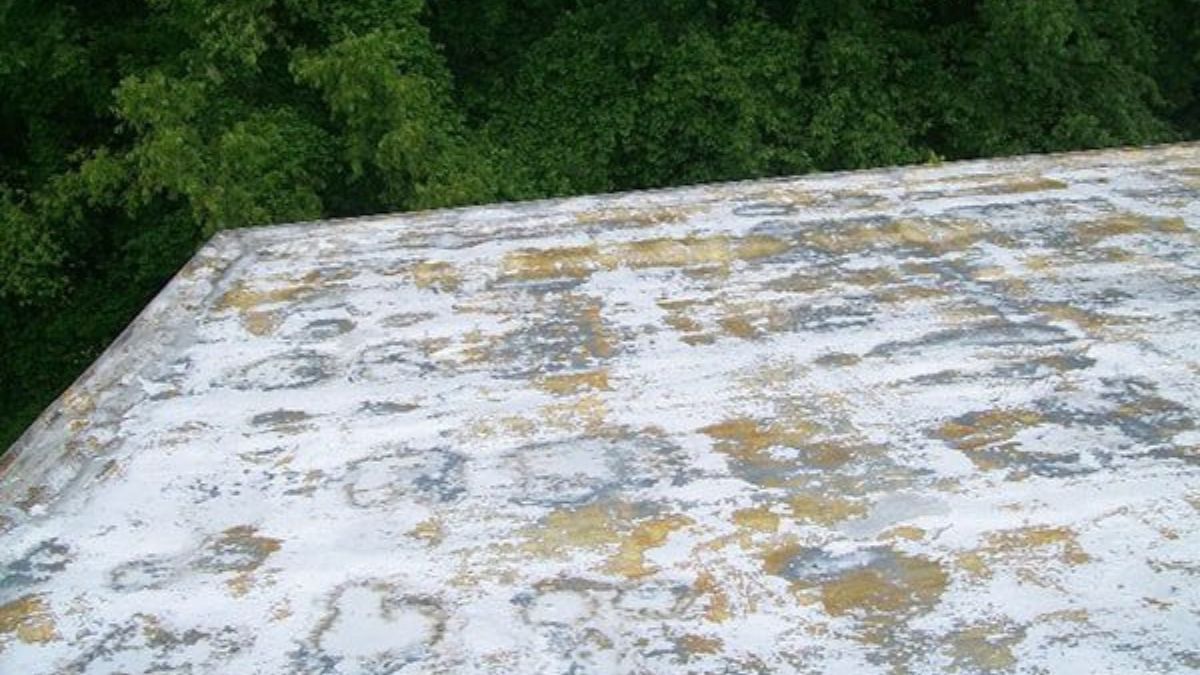
Quick Answer: Then you may have a serious problem. In most cases, it’s because the foam was not recoated in time. Exposed foam will degrade within 72 hours from UV rays. If foam is exposed, your roof is slowly degrading under UV exposure. The faster you have someone evaluate your roof, the less expensive the repair or restoration will be. The problem can only get worse.
Quick Story: I was manning our booth at the Ohio School Board Association in November 2025. A curious Director of Facilities saw a sample of a spray foam roof sitting on our table:
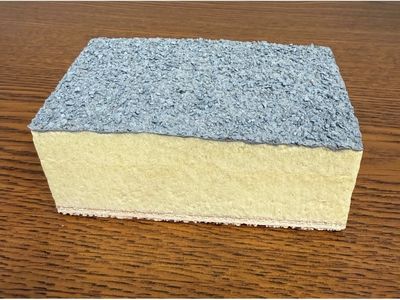
And they asked me, “What happens if the foam is exposed?”
The Complete Answer: A spray foam roof has four parts:
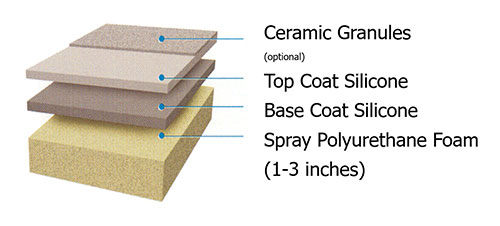
The base and topcoat of coating are there for a few reasons, but the most important is to keep the foam protected from UV rays.
The coating comes in a variety of thicknesses. The thickness determines the warranty length:
- A 20-mil dry film thickness will get you a 10-year warranty.
- A 25-mil dry film thickness will get you a 15-year warranty.
- A 30-mil dry film thickness will get you a 20-year warranty.
When the warranty period is over, there’s likely only a few mils of coating left. At that time, a recoat is recommended.
In simple terms, a recoat is making the sure the roof is clean and dry, then installing another layer of protective coating on.
Here is a short video showing a recoat installation:
A recoat grants a new warranty. And the process can repeat over and over again.
Maybe you ask…in what scenarios would there be exposed foam? Here are some:
- The building owner never did a maintenance plan, and the roof was neglected when minor damage occured
- When the warranty was over, a recoat was not performed
- Bad foam was installed
- Coating was installed too thin
Let’s talk about each one of these a little bit:
Four ways your commercial roof can have exposed foam
No maintenance plan
Once the spray foam roof is installed, it needs basic maintenance to last. It’s no different than your car. You can expect a new car to last 10 years, but how long would it last if the oil was never changed?
When there’s no maintenance on a spray foam roof (actually…any roofing system, TPO, EPDM, Metal, any of them) the roof will simply not last.
A simple example is when flying debris, bird’s pecking, or a maintenance guy drops a tool on the roof and foam is exposed.
If there was a maintenance plan, someone would’ve been on that roof the next Spring or Fall, saw the damage, and could caulk/repair it, and the foam is no longer exposed.
If no one goes onto the roof for multiple years, a small repair today could turn into a much larger (and expensive) repair later.
Not performing a recoat
Sometimes the phrase “if it’s not broke, don’t fix it” comes into play in commercial roofing. If the roof isn’t leaking, then why spend money on it?
Sometimes building owners change and the new owner is unaware of how the spray foam roofing system works.
And a recoat isn’t cheap. It costs roughly 1/3 to ½ of the initial installation.
Either way, at some point, the coating isn’t going to last forever, and the foam will become exposed.
Bad foam was installed
There’s a science and an art to installing good closed-cell spray polyurethane foam.
There’s heating, pressures, spray patterns, speeds of foam, different cure rates, and probably a hundred more variables that can affect whether good foam is installed or not.
It’s absolutely critical to find a contractor that knows what they are doing.
If you chose a contractor solely because of price, location, whatever it may be, and they aren’t experts in spray foam, bad foam could be installed.
Bad foam can blister or split and become exposed to the sun before you expected it to.
Coating installed too thin
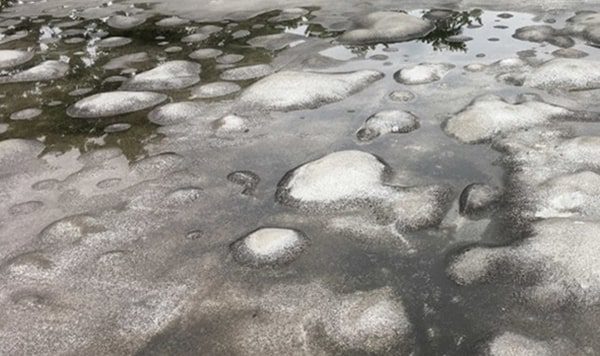
The elastomeric coating that’s installed over foam is the only thing protecting the foam from UV rays. If someone says they are going to install 20 mils, and they put down 10, your foam is highly likely to see the sun well before the contractor told you it would.
This is where contractor integrity matters.
As a building owner, property manager, etc. Someone not knee-deep into roofing materials every day. Would you be able to tell a 20-mil thickness versus 10?
A mil is one thousandth of 1 inch. The naked eye would have a very hard time telling the difference.
An installer uses a comb gauge to measure wet film thickness and/or a digital or magnetic gauge to determine thickness after the coating cures.
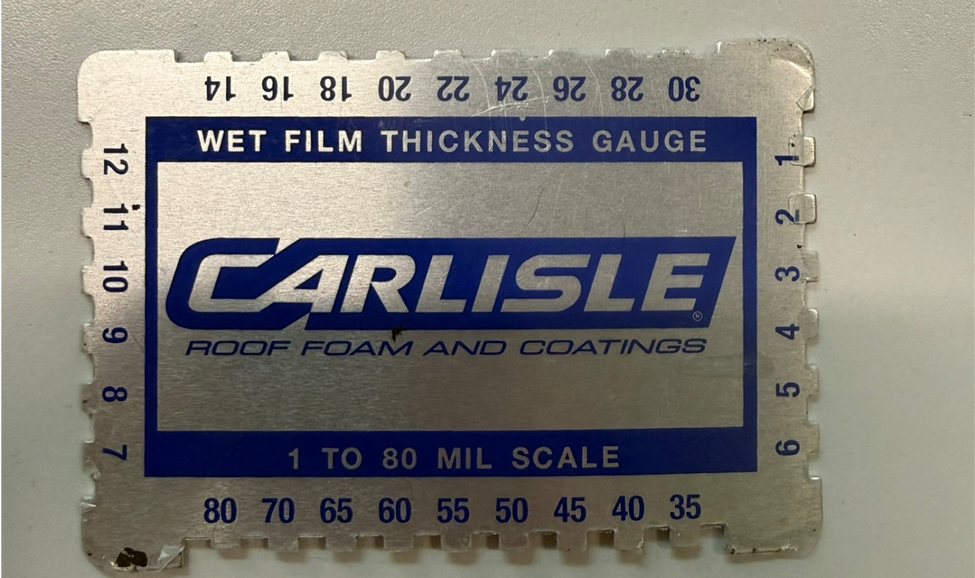
An installer could cut corners by using less material than they said they would, taking advantage of an uneducated client.
A thin application of coating will expose foam sooner than expected.
Conclusion: Exposed Foam Demands Immediate Action
When spray foam is exposed, deterioration begins immediately — and the longer it’s left unaddressed, the more expensive the solution becomes.
Closed-cell spray polyurethane foam is not designed to be exposed to UV light. Once the protective coating is gone, the sun immediately begins breaking it down. What may look like a small, harmless patch can quickly turn into chalking, cracking, pitting, and eventually water infiltration.
The good news?
If caught early, the damage can often be repaired and the roof can be recoated — extending its life for another 10, 15, or even 20 years.
If ignored, what could have been a recoat may turn into a scarf or complete tear-off.
If you suspect exposed foam:
- Do not wait for a leak.
- Do not assume it will “be fine.”
- Have the roof inspected as soon as possible.
Spray foam roofs are one of the most renewable roofing systems in commercial construction — but only if the foam remains protected.
Exposed foam is not something to monitor.
It’s something to address.
If you are unsure whether your foam is exposed, have a qualified spray foam roofing contractor inspect it. A free, 30-minute inspection today could save you hundreds of thousands in replacement costs later.
