
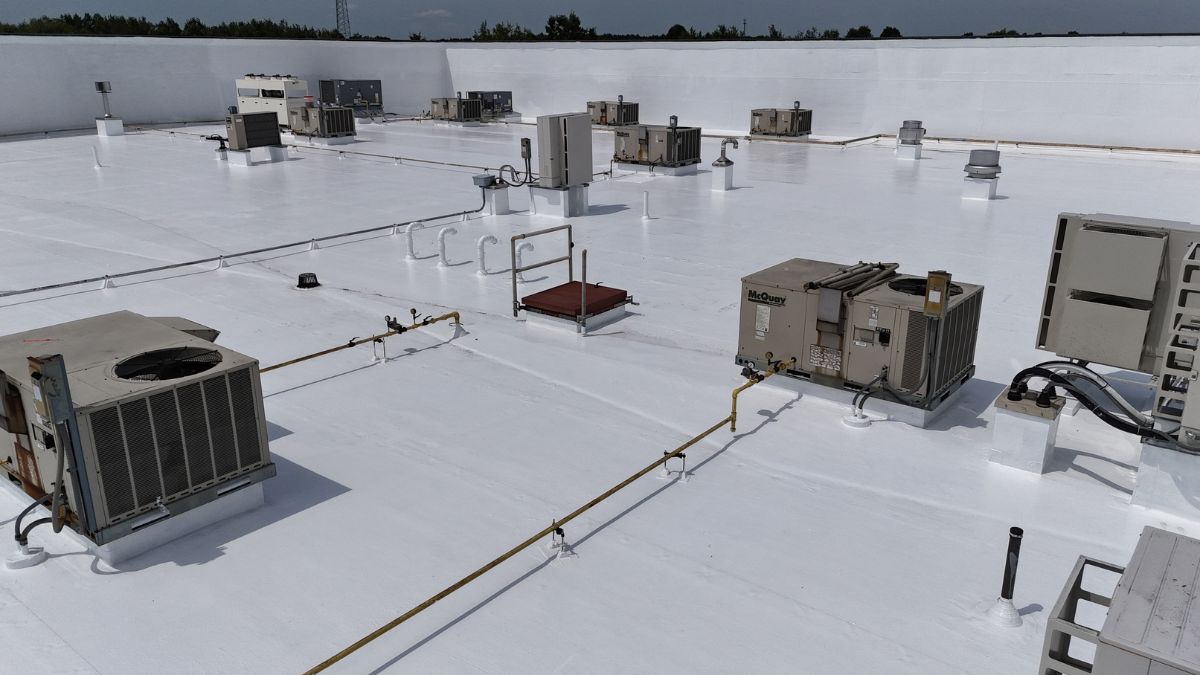
When most building owners think about replacing their roof, they focus on the visible costs: materials, labor, and disposal. But there are hidden expenses that can dramatically increase your total project cost — especially when a complete tear-off is involved.
One of the biggest advantages of installing a silicone roof coating system over your existing roof is that it can eliminate the 100% tear-off, saving you time, money, and logistical headaches.
It CAN eliminate…
Yes.
You can’t simply apply a coating over any existing roof and expect it to be fine. Well, I guess you can…but that would be a very unethical thing for a contractor to do.
To get a manufacturer’s warranty, there are three conditions the roof must meet:
- Around 75% or more of the roof’s insulation is dry
- The seams and flashings have a good amount of adhesion (they are not blown open)
- And there must have been annual maintenance on the roof
This article provides a detailed explanation of the three conditions.
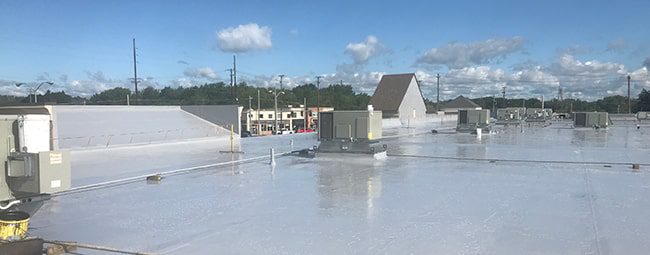
In some cases, 3% of the roof’s insulation and membrane need to be removed and replaced before the coating prep process can begin. Other times it’s 0%. And other times it’s 20%.
But if 50% of the roof is wet. It’s beneficial to the building owner to rip everything off and start over.
The point is, minimizing tear-off is a good thing. And if the building owner/representative is proactive enough, having zero tear-off and avoiding the following “hidden” costs can really save money.
Let’s break down what those hidden costs are.
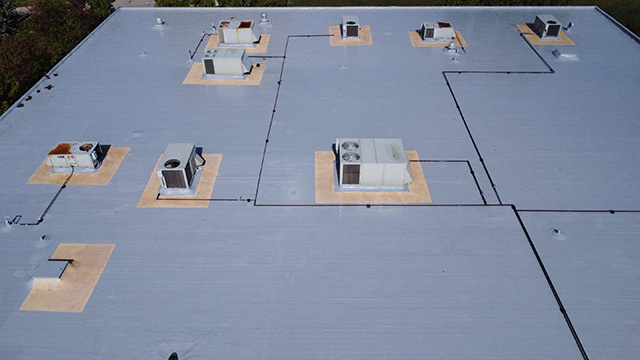
1. The Tear-Off Adds More Than Just Labor
Tearing off an existing roof isn’t just noisy and disruptive — it creates several expensive ripple effects:
- Landfill costs: Every square foot of old roofing that’s removed must be disposed of. That’s thousands of pounds of material heading to landfills.
- Labor intensity: Tear-offs require large crews and long hours just to remove and clean up debris before a new system can even begin.
- Material replacement: Once you tear off, you have to replace what you removed — insulation, cover board, and sometimes even the deck itself.
These factors alone can increase the cost of a traditional tear-off to twice that of a restoration project using silicone coatings.
You know what else adds to hidden costs…
2. The Cost of Interior Protection
One cost that’s often overlooked is interior protection — temporary barriers and netting systems installed inside the building to protect sensitive equipment, products, and workers from falling debris or dust during a tear-off.
Depending on your facility, this can range from $2.50 to $10 per square foot.
- Basic interior protection: $2.50–$5 per sq. ft.
- Netting systems (for heavier debris or deck replacement): $6–$10 per sq. ft.
These costs vary based on the type of facility and the level of access the interior protection company has to complete their work.
For example, a recent discussion with one of our project managers, Ryan Mains, revealed a real-world scenario:
“A customer with an 80,000 sq. ft. production warehouse was paying around $2.50 per sq. ft. for interior protection just for a small section of roof work,” he explained.
“They were producing medical-grade electronics, so even a speck of dust or a static charge could ruin equipment. Their protection system stayed up for the entire two-week project.”
In some cases, especially in electronics or food production facilities, interior protection isn’t optional — it’s mandatory for safety and compliance reasons.
NOTE: Even if there’s no deck replacement, interior protection may be needed. With the medical-grade electronics facility, roofers using shovels for tear-off would cause dust to fall from the ceiling. Same with a food processing plant. Even though the roof is being torn off down to the deck and the deck remains in place, work on the roof may still require interior protection.
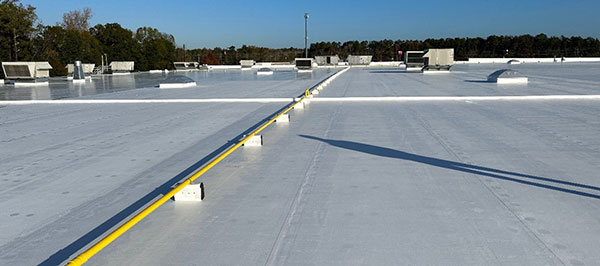
3. Work Schedule Greatly Impacts the Cost
Another factor that drives up the price is how often the interior protection crew can work.
If your building allows consecutive workdays (Monday through Sunday), the setup and removal of interior protection occur only once — saving time and money.
But if work is limited to weekends only, the cost skyrockets. Crews must remobilize each weekend.
“Some places only allow weekend work to avoid interrupting production,” our rep explained. “Instead of finishing in five straight days, you’re looking at two or three weekends — which means more labor, more trips, and higher costs.”
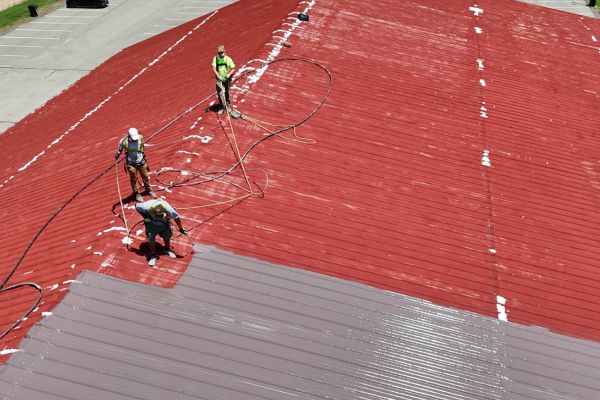
4. Why Silicone Roof Coatings Avoid All of This
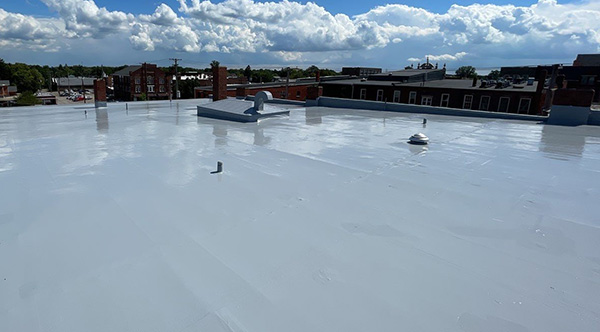
With a silicone roof coating system, your existing roof stays in place. There’s minimal tear-off, no debris, and no need for interior protection.
- No landfill waste
- No downtime for your facility
- No interior protection
- No exposure to weather during deck replacement (if necessary)
Instead, your roof is cleaned, repaired, and coated, creating a seamless, watertight membrane that extends the life of your roof by 10–20 years.
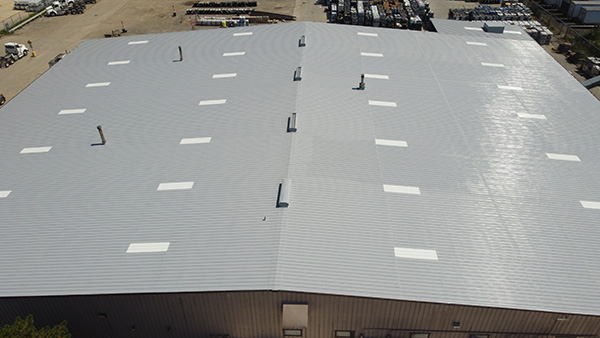
5. Be Proactive — Don’t Wait for Leaks
When it comes to roof coatings, timing is everything. Too many building owners wait until the roof leaks to take action — and by then, it’s often too late for a coating system to be a simple solution.
Once water has saturated over 25% of the total roof’s insulation, a complete tear-off becomes unavoidable, which means higher costs, more downtime, and potential interior protection requirements.
A proactive approach is key. If your roof is in good condition and under warranty, the best time to consider a coating system is when the warranty expires. Being proactive allows you to:
- Extend the life of your existing roof before problems start
- Avoid the surprise of leaks and emergency repairs
- Plan for predictable maintenance cycles
- Maintain warranty coverage through renewals every 10, 15, or 20 years
For large corporations, this also means predictable budgeting. With a renewable coating system, you can forecast roofing costs years in advance, rather than reacting to unexpected failures.
On the other hand, waiting until the roof fails can result in:
- Sudden leaks and water damage
- Emergency tear-offs
- Production interruptions
- The need for costly interior protection
- Overall costs that are 3–5x higher than a proactive coating system
Taking a proactive approach not only protects your roof — it protects your budget, operations, and provides peace of mind.
NOTE: It’s 100% true…a complete tear-off and replacement, along with interior protection and lost labor can be 5x more expensive than installing a coating system. We are on a project right now in October 2025, installing a coating system. They ran the numbers over a 5 year period on what the roof costs would be if they did (or did not) install a coating system. If they waited, the costs would be 5x higher…resulting in millions of extra dollars spent that would’ve been avoidable.
6. The Bottom Line
When comparing roof replacement options, always factor in the hidden costs of a full tear-off — not just materials and labor, but also interior protection, downtime, and risk.
In many cases, a silicone roof coating system can save building owners $3 to $10 per square foot simply by avoiding those hidden expenses.
Interested in Learning If Your Roof Qualifies?
We can evaluate your existing roof and determine whether a silicone restoration system is a fit.
